



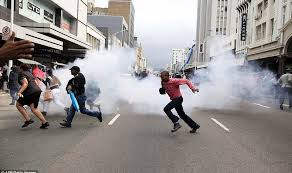
South African police on March 25, 2026, fired rubber bullets and teargas to disperse hundreds of demonstrators protesting against Nigerians and other foreign nationals in the coastal city of Durban.
The action followed a march by local organisations pressing for stricter enforcement of immigration laws and tighter border controls.
The demonstration and police response took place amid ongoing national debates over immigration policy and law enforcement.
Political and civic groups, including members of the March and March Movement, ActionSA, the Inkatha Freedom Party (IFP), and the uMkhonto we Sizwe (MK) Party, joined the march.
Protesters called on the government to strengthen action against undocumented foreign nationals living in South Africa.
Organisers said their aim was to spotlight what they described as “persistent shortcomings in immigration enforcement, border control and regulatory oversight”.
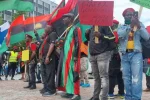
Photos from the scene showed demonstrators waving placards and chanting as they moved through central Durban before police intervention.
Local reports indicated that police initially held back the crowd from heading toward the beachfront but later used rubber bullets and teargas when a smaller group broke away from the main march. Some arrests were reported, though official figures were not immediately available.
Political figures at the protest included Herman Mashaba, leader of the ActionSA party, who addressed the crowd. He reiterated calls for more decisive immigration enforcement.
“We are seeing our government allowing our country to be flooded by groups from all over the world as far as Pakistan, Bangladesh, Nigeria, Mexico, all over the world. So we are saying to our government this is unacceptable,” Mashaba said.
Among the marchers was 81‑year‑old Thembi Dlamini from Clermont, who repeated concerns voiced by many participants about job competition and immigration documentation.
“People can call us names but we cannot allow a situation where our country is being destroyed before our very own eyes,” she said.
South Africa, as one of the continent’s most industrialised economies, attracts migrants from across Africa. Official statistics indicate that foreigners make up an estimated 5.1 percent of the population, with some three million non‑citizens residing in the country.
Unemployment remains high, and competition for jobs is frequently cited by local groups as a driver of anti‑immigrant sentiment.
The protest took place in the context of continued public debate and previous demonstrations addressing immigration and enforcement.
Critics of protest movements like the one in Durban have noted concerns about potential exclusion or discrimination against documented migrants and refugees.
Meanwhile, authorities have emphasised the need to balance enforcement of immigration laws with protection of fundamental rights and social cohesion.
The events highlight persistent tensions in South Africa over immigration, job competition, and government enforcement of immigration policy.
Use of force by police underscores challenges in managing demonstrations that intertwine civic demands with sensitive social issues.
Continued public and political attention to immigration policy may influence national debates ahead of local elections.
Continued engagement by civil society, government agencies, and affected communities will determine how such demonstrations are managed and how policy responses evolve.