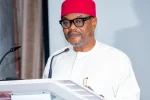






Former Minister of Sports, Solomon Dalung, has reignited the Nigeria insecurity debate with strong criticism of the federal government’s handling of terrorism and nationwide abductions. He accused the administration of President Bola Tinubu of lacking the political will to confront worsening insecurity across the country.
Dalung made the remarks on Friday during an appearance on Arise Television’s Morning Show. He said the government appeared more focused on political survival ahead of the 2027 general elections than on protecting lives lost to terrorism and kidnappings.
He argued that security agencies possess advanced tools but fail to deploy them effectively against criminals. According to him, the state responds faster to critics than to armed groups operating in forests across the country.
“Government seems not to have the political will to deal with it. They have all the gadgets to track anybody who criticises the government — they can pick him up in the next five minutes. But they don’t have equipment to track terrorists who display huge phones in the forest, behead teachers, abduct schoolchildren, torture them in the forest, produce videos and send,” he said.
Dalung also criticised the Minister of Information’s call for national unity against terrorism. He described the appeal as poorly timed and an indication of deeper governance failure rather than a strategic response to insecurity challenges.
“I think it’s a statement confirming that the federal government has completely and woefully failed. They don’t seem to have any idea of a solution to the ravaging insecurity that is across the country,” he said.
He further claimed that Nigeria’s security system suffers from coordination failures. He said intelligence agencies and military institutions operate independently rather than collaboratively, reducing effectiveness in counterterrorism operations.
According to him, the struggle for institutional relevance has weakened national response capacity. He added that security agencies often compete for presidential attention instead of sharing intelligence seamlessly.
Dalung also warned that terrorist groups are developing self-sustaining operational bases, which he described as a “parallel forest economy.” He questioned the effectiveness of foreign military support in addressing the situation.
“We were told that the Americans are here with us. If the Americans are here with us, what have they been doing? We have not felt their impact,” he said.
He urged government authorities to empower local communities to take greater responsibility for their security. He also expressed concern that political dynamics ahead of 2027 could deepen national instability.
Responding to Dalung’s remarks, political scientist Obafemi George defended the administration’s approach, saying reforms require time to yield results. He argued that security improvements and economic adjustments should be assessed within a longer timeline.
George pointed to Nigeria’s improved sovereign credit rating from B- to B by Standard and Poor’s as evidence of economic stabilisation. He also linked rising insecurity to regional instability following the withdrawal of French forces from the Sahel.
He said the government has recorded operational gains in security, including rescue missions carried out in May across Goza and Katsina. According to him, these interventions reflect ongoing improvements in counterterrorism efforts.
George maintained that governance outcomes should be measured through key performance indicators across sectors such as security, infrastructure, education, and health. He argued that national transformation is a gradual process rather than an immediate achievement.
He compared Nigeria’s reform trajectory with global development examples, including China, Rwanda, and Dubai, noting that long-term planning is essential for sustained progress. The contrasting views highlight the deepening Nigeria insecurity debate, as citizens and experts continue to assess government performance against rising security challenges and economic pressures across the country.