




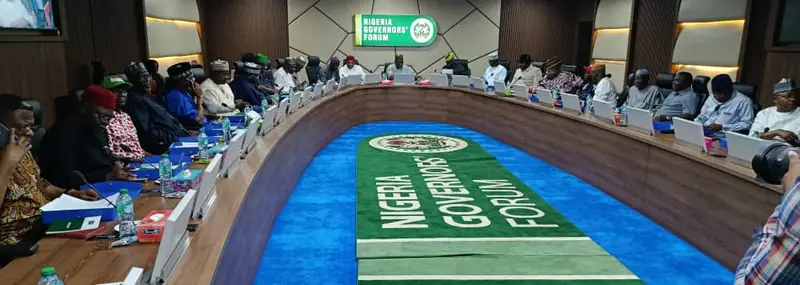
The 36 state governors under the Nigeria Governors’ Forum (NGF) have reaffirmed their support for a state police framework, stressing that any new policing structure must be constitutionally sound and consistent with federalism and citizens’ rights. The position was adopted at the Forum’s second meeting held in Abuja, where governors also reviewed proposals on power, nutrition, and agricultural development. The decision reflects ongoing efforts to address security challenges while strengthening governance structures across the country.
Calls for state policing have gained momentum in recent years as governments seek new approaches to tackling insecurity. Supporters argue that decentralised policing could improve local intelligence gathering and response capabilities, while critics have raised concerns about oversight, accountability, and potential abuse.
In April 2026, the governors endorsed the proactive development of a state police framework by the NGF Secretariat in preparation for proposed constitutional amendments. The framework outlines key requirements including governance structures, financing models, human capital standards, digital systems, and oversight mechanisms.
According to a communiqué signed by NGF Chairman and Kwara State Governor AbdulRahman AbdulRazaq, governors received a presentation from the Forum’s secretariat and a delegation of state attorneys-general on efforts to support the establishment of state police in Nigeria.
The communiqué stated that governors reviewed proposed constitutional amendments and implementation frameworks during consultations with the attorneys-general.
Reading the communiqué after the meeting, Ogun State Governor Prince Dapo Abiodun said: “The Forum received a presentation from the NGF Secretariat and a delegation of the Honourable Attorneys-General of the States on efforts to support establishing State Police in Nigeria. It noted a dedicated consultation with the attorneys-general to review the proposed constitutional amendments and frameworks.”
He added: “Governors emphasised the need for the State Police to be constitutionally sound and aligned with federalism and citizens’ rights. The Forum noted the collaborative effort and added that the consultation outcomes would strengthen the states’ collective position.”
Beyond the state police framework, governors reviewed the National Solar Super-Grid (NSSG) Initiative, a proposal aimed at expanding electricity access through large-scale decentralised solar generation linked to a national transmission network. They noted its potential to support industrialisation, energy security, and economic growth.
The Forum also received updates on the National Nutrition 774 (N-774) Initiative and ongoing work on the National Nutrition Bill. Governors reaffirmed commitments to reducing child malnutrition and strengthening nutrition governance across the country.
The governors’ endorsement of a state police framework signals continued momentum behind constitutional reforms that could reshape Nigeria’s security architecture. Any eventual implementation would require legislative approval and clearly defined safeguards to protect citizens’ rights and institutional accountability.
The discussions on electricity, nutrition, and agriculture also underscore efforts by state governments to address broader development challenges through coordinated action with the Federal Government, development partners, and international institutions.
The NGF resolved to deepen consultations with relevant stakeholders as discussions on state policing and constitutional amendments continue. Governors also pledged ongoing collaboration on power sector reforms, nutrition initiatives, and agricultural programmes, including partnerships with the Federal Government and the World Bank to support development outcomes across participating states.