





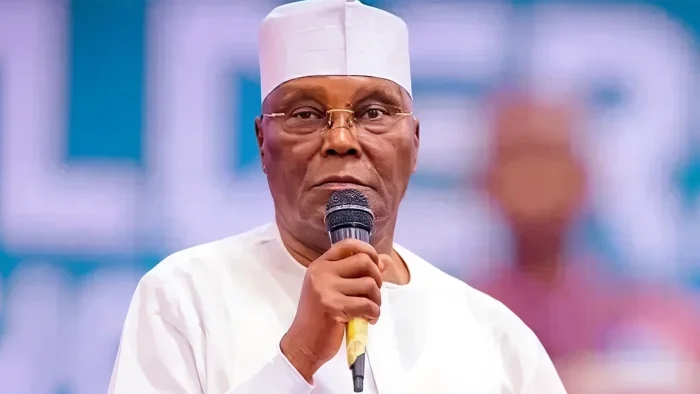
Former Vice President Atiku Abubakar has raised concerns over an unexplained payment made into his personal bank account, saying the transaction could expose him to unwanted associations with people or activities unknown to him.
The payment reportedly carried the description “Contribution Electioneering Campaign,” despite Atiku and his political organisation insisting that they neither requested nor authorised the funds. Atiku’s spokesman, Phrank Shaibu, said the former Vice President had no knowledge of the individual or organisation behind the transaction.
“Neither His Excellency nor his campaign solicited, authorised or has any knowledge of the individual or entity behind the unauthorised payment,” Shaibu stated.
The issue, according to sources, goes beyond the unexpected arrival of money in Atiku’s account. There are concerns that an unexplained financial transaction could potentially be used to establish an association between the recipient and individuals or activities with which the recipient has no connection.
Atiku’s camp is particularly concerned about the possibility that unexplained funds could later generate questions about links to criminal activities, including fraud, drug trafficking or terrorism financing.
However, there is currently no evidence that the payment originated from any terrorist, drug-trafficking or other criminal organisation. The concern, rather, centres on the identity and intention of the sender, as well as the potential consequences of an unexplained transaction appearing in the account of a prominent political figure.
Another question troubling Atiku’s camp is how an unknown individual obtained the banking details of an account described as strictly private. Shaibu said the account details were not publicly available, raising concerns about how they could have been obtained by the sender.
“The account is a strictly private one whose details are not in the public domain. This raises a fundamental question: How did unknown persons obtain the confidential banking details of a private citizen?” he asked.
The development has also triggered questions about whether someone with authorised access to sensitive financial information could have improperly disclosed the account details. Shaibu described this possibility as particularly disturbing, saying confidential information may have been obtained through individuals with privileged access.
The bank where the payment was received has reportedly commenced an investigation into the transaction. According to findings, the financial institution, described as one of Nigeria’s five largest banks, was expected to provide Atiku with feedback on its findings over the weekend. The investigation is expected to focus on the origin of the payment and the circumstances surrounding the transfer.
Further checks indicated that the funds originated from an OPay account, a development that could provide investigators with additional transaction records as they attempt to establish the source. However, Atiku’s camp remains concerned that identifying the account from which the money was transferred may not necessarily reveal the person who ultimately initiated or motivated the payment.
The former Vice President has also framed the matter as a broader concern about financial privacy and security. He argued that if confidential banking information belonging to a former Vice President and presidential candidate could be obtained and used without authorisation, ordinary Nigerians could face similar vulnerabilities.
“If the private banking information of a former Vice President and a leading presidential candidate can be accessed and deployed for reasons yet unknown then no Nigerian’s financial privacy is safe,” Atiku was quoted as saying.
His camp further warned that unauthorised access to sensitive financial information could potentially expose account holders to criminal threats. The matter has reportedly been brought to the attention of security agencies.
For Atiku, the central issue is therefore not the unexpected money itself. Instead, several questions remain unanswered: Who sent the money? Why was it described as an electioneering campaign contribution? How did the sender obtain details of a private account? And what was the intended purpose of the transaction?
Those questions have taken on added political significance as Nigeria approaches the 2027 general elections, with Atiku remaining a prominent opposition figure.
Until the bank and relevant authorities establish the source and circumstances surrounding the payment, Atiku’s camp is treating the transaction not as an unexpected financial benefit, but as a potential security and political red flag.