





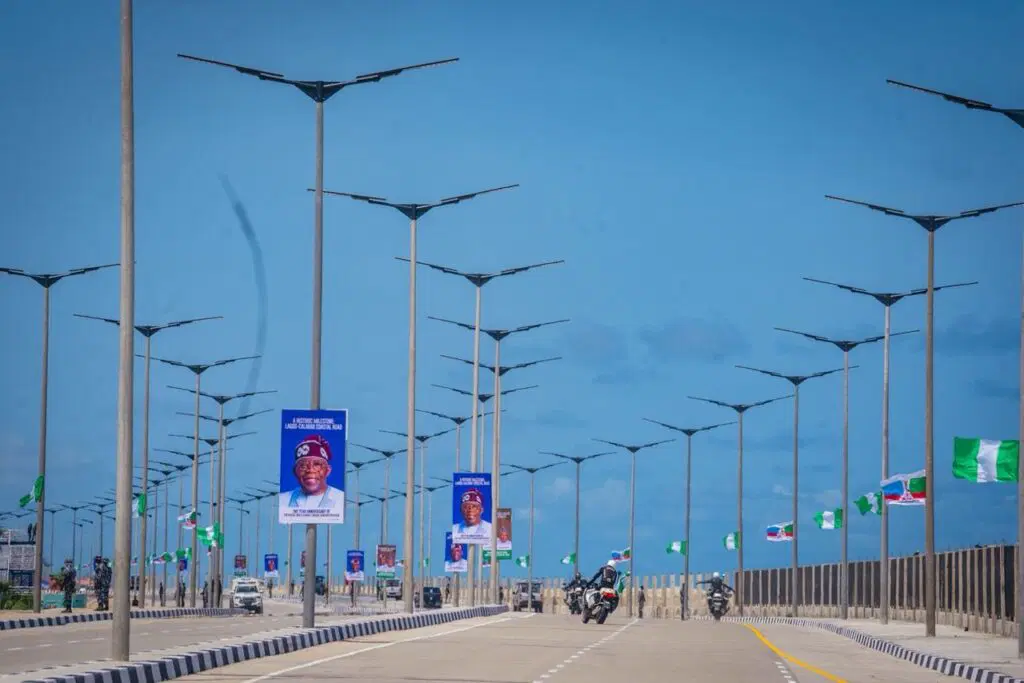
The Federal Government has officially renamed the Lagos-Calabar Coastal Highway as the President Bola Ahmed Tinubu Coastal Highway, describing the move as recognition of President Bola Tinubu’s long-standing vision behind the transformative infrastructure project. Minister of Works Dave Umahi announced the decision during a media briefing in Abuja on Thursday, stating that the 750-kilometre highway traces its origin to an idea conceived by Tinubu nearly three decades ago while serving as Governor of Lagos State.
Umahi explained that the decision was reached after consultations with the ministry’s leadership, including the Permanent Secretary, Minister of State, directors and other senior officials. According to him, the renaming honours the President’s commitment to turning a decades-old vision into reality.
“That highway is named President Bola Ahmed Tinubu Coastal Highway,” Umahi said.
He added that while many people have ambitious ideas, only a few possess the determination and opportunity to bring them to fruition. The minister noted that Tinubu conceived the coastal highway project about 27 years ago during his tenure as Lagos governor, describing its execution as the fulfilment of a vision that has endured over the years.
Umahi also disclosed that President Tinubu has approved the extension of the Fourth Legacy Highway by an additional 400 kilometres, increasing the proposed corridor from about 700 kilometres to approximately 1,100 kilometres. According to the minister, the President also approved several major infrastructure projects aimed at improving connectivity across the country.
These include: reconstruction of the Lagos-Ibadan Expressway using reinforced concrete pavement, completion of the long-delayed Ibi Bridge in Taraba State, construction of the 5.76-kilometre Lau Bridge, Dualisation of an additional 400 kilometres of the East-West Road.
Providing an update on construction, Umahi said work is progressing simultaneously across multiple sections of the Tinubu Coastal Highway. He explained that the first section, stretching from Victoria Island to Eleko Village in Lagos, is serving as a model for modern highway construction standards in Nigeria.
The second section, extending from Eleko to the Lagos-Ogun boundary, has reached about 60 per cent completion and is expected to be substantially delivered by November. Construction activities are also ongoing in Cross River, Akwa Ibom, Ogun and Ondo states, as the Federal Government pushes ahead with what it describes as one of Nigeria’s most ambitious road infrastructure projects.
The Lagos-Calabar Coastal Highway forms part of the Federal Government’s broader strategy to improve regional connectivity, stimulate economic growth, enhance trade and tourism, and modernise Nigeria’s transport infrastructure.