






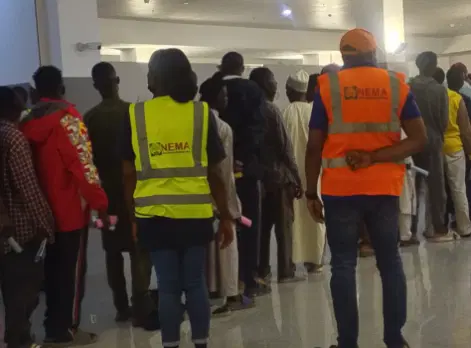
The National Emergency Management Agency (NEMA) on Monday received 708 stranded Nigerians who were returned from Niamey, Niger Republic, the agency said, as part of a coordinated federal repatriation effort.
The returnees were brought back to Nigeria in a repatriation exercise coordinated by the Federal Ministry of Foreign Affairs and handled on arrival by NEMA officials at the Malam Aminu Kano International Airport in Kano.
Repatriation of stranded citizens abroad is regularly facilitated by Nigerian authorities through missions such as NEMA and the Ministry of Foreign Affairs to assist nationals who are unable to return home independently.
NEMA’s Head of Operations in Kano, Dr. Nura Abdullahi, said the group of returnees arrived at about 4:08 p.m. in 12 buses, and were immediately taken through a profiling process.
The 708 returnees included 292 male adults and children and 416 female adults and children from different parts of Nigeria, including Katsina, Kano, Jigawa, Benue, Borno, Yobe, Zamfara, Kaduna, Kogi and Niger states.
Abdullahi said the returnees were provided with food and temporary shelter on arrival. They were also given blankets, mosquito nets, and dignity kits containing toiletries, wrappers, sanitary pads, and other essentials.
He stated that medical personnel from the Nigerian Red Cross were present to provide treatment to those who were sick, with severe cases to be referred to appropriate state health facilities.
“We have fed the returnees and made arrangements for temporary shelter,” Abdullahi said, adding that after profiling on Tuesday morning, they would be transported to their respective states.
In his remarks, the Kano Field Coordinator of the National Commission for Refugees, Migrants and Internally Displaced Persons (NCFRMI), Hajiya Luba Liman, described the repatriation exercise as a whole‑of‑government approach to evacuate stranded Nigerians.
Abdullahi also advised the general public, particularly Nigerian youths, to avoid endangering their lives by attempting risky travel in search of greener pastures abroad.
The exercise highlights ongoing government efforts to assist Nigerians who find themselves unable to return home from abroad without official support.
Provision of essential items, shelter, and healthcare support on arrival underscores humanitarian components of the repatriation process, and the subsequent profiling and onward transportation to home states is intended to complete the reintegration phase.