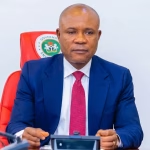





The Minister of Power, Adebayo Adelabu, is facing public criticism as his electricity promise fails to deliver improved supply two weeks after assuring Nigerians of relief from persistent outages. The pledge, made on March 24 in Abuja, had set expectations that power supply would improve within a defined timeline, but reports across several states indicate that the situation has largely remained unchanged.
The development has renewed concerns over the reliability of electricity supply and policy implementation in Nigeria’s power sector.
The electricity promise fails amid ongoing structural challenges in Nigeria’s electricity sector, including gas supply constraints, infrastructure limitations, and financial deficits across the value chain. During a media briefing, Adelabu had apologised for widespread blackouts, acknowledging their impact on households, schools, and industries, particularly during the dry season.
He stated, “I want to apologise to Nigerians… for this temporary issue that is leading to hardship being experienced,” and assured that “two weeks from now, we should start seeing improvements in supply.”
The assurance followed disruptions linked to reduced gas supply to power generation companies and technical issues affecting electricity distribution nationwide.
Two weeks after the pledge, multiple reports from Abuja, Lagos, and other states indicate that the electricity promise fails to translate into consistent improvement in supply. A cross-country assessment showed that many households and businesses continue to experience prolonged outages and limited daily electricity.
In Utako, Abuja, a resident, Ekwa Mbuk, said: “So why are we at Utako District subjected to darkness for another night? The heat is sickening.” He added, “Since last night, no light… we’ve had only an hour of light. Are we getting what we’re paying for?”
Similar concerns were raised in Lagos, where Iyke Oscar questioned the billing structure: “Why are we still paying as Band A, if we can’t have light up to 24 hours?”
Across other regions, consumers reported erratic supply patterns characterised by long outages followed by brief restoration periods. Another respondent in Delta State stated, “Electricity in Nigeria is still a joke.”
Experts also weighed in on broader sector reforms. Dr. Muda Yusuf, Chief Executive Officer of the Centre for the Promotion of Private Enterprise (CPPE), said: “This is a pre-election period, and electricity is becoming a campaign issue.”
He added that structural challenges must be addressed for sustained improvement, noting that tariff reforms may be necessary but should be gradual.
The failure of the electricity promise fails timeline underscores ongoing gaps between policy commitments and service delivery in Nigeria’s power sector. Persistent outages continue to affect productivity, increase operating costs for businesses, and reduce quality of life for households.
The situation also highlights the need for structural reforms, including improved gas supply, infrastructure investment, and financial sustainability within the electricity market. With electricity increasingly tied to economic performance, inconsistent supply may continue to influence industrial output and investor confidence.