




The Federal Government has intensified efforts to rescue abducted pupils and teachers in Oyo and Borno states, declaring that no effort would be spared in securing their freedom and dismantling terrorist networks responsible for the attacks. The renewed commitment was announced on Thursday during a special national security briefing in Abuja, where the government unveiled additional security measures, including the deployment of a specialised rescue team and the recruitment of 1,000 forest guards. Officials said the mission to rescue abducted pupils remains a top priority under President Bola Ahmed Tinubu’s administration.
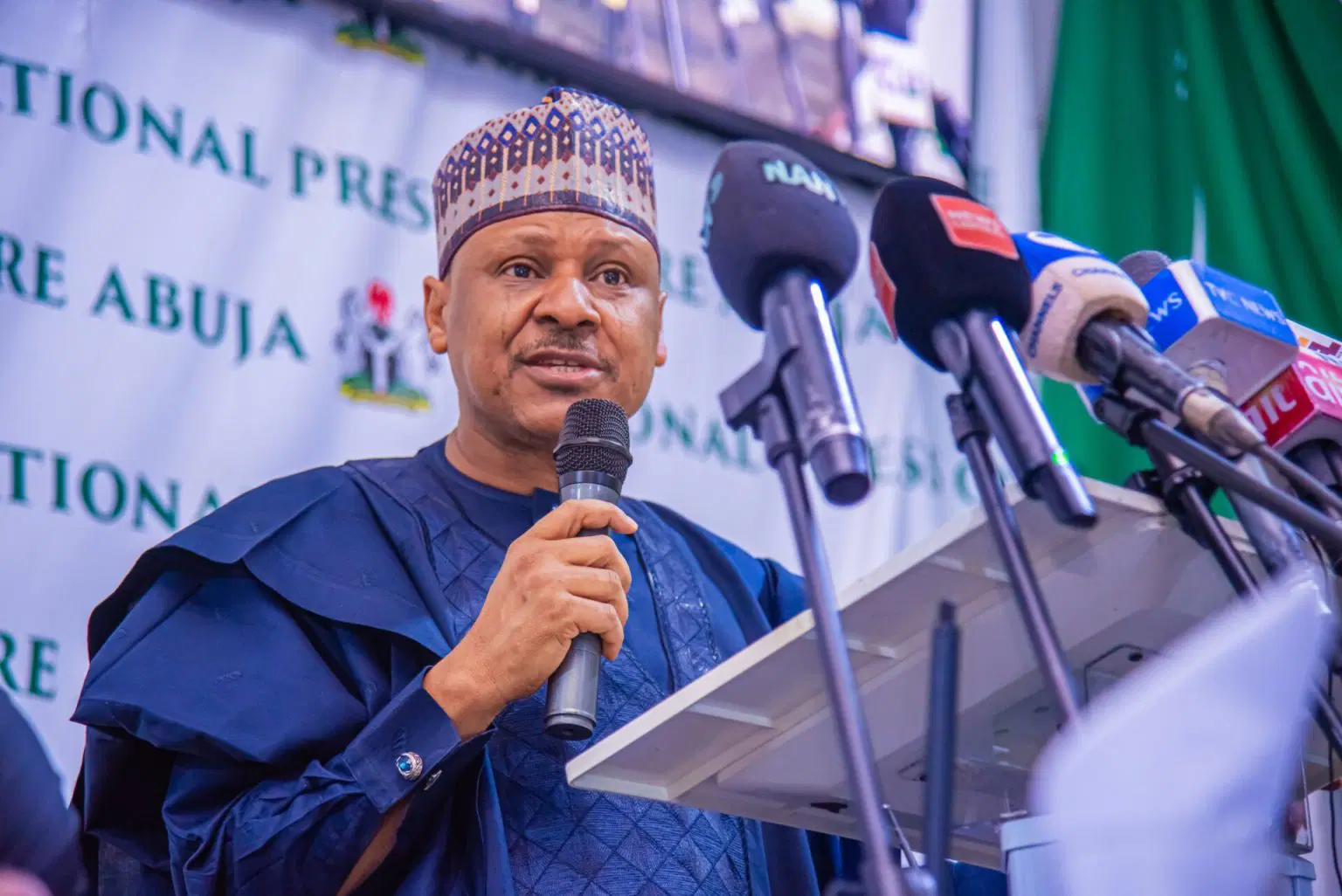
The security briefing, tagged #UniteAgainstTerror, was convened amid growing concern over recent kidnappings involving schoolchildren and teachers in Oyo and Borno states. The incidents have generated national outrage and renewed discussions about the protection of schools and vulnerable communities.
Speaking at the briefing, the Minister of Information and National Orientation, Mohammed Idris, delivered President Tinubu’s message to Nigerians and described the abductions as a direct assault on the nation’s future. According to Idris, the administration views attacks on schoolchildren as a threat to national development and has mobilised all available resources to ensure the victims are safely returned.
Delivering the President’s position, Idris declared: “No child belongs in captivity.” He assured families of the victims that the Federal Government was fully committed to securing their release and bringing those responsible to justice.
“The president has directed that every lawful instrument available to the Nigerian state be deployed towards achieving this objective,” Idris said.
The minister disclosed that a specialised rescue team had already been activated, while plans had been approved for the recruitment of 1,000 forest guards to strengthen security across vulnerable communities.
According to him, intelligence gathering, aerial surveillance, community engagement, and coordinated search-and-rescue operations are ongoing in both Oyo and Borno states as part of efforts to rescue abducted pupils and teachers. Idris said the administration’s security strategy extends beyond military action and is driven by intelligence, institutional reforms, and plans to establish a modern policing framework capable of addressing local security challenges.
Highlighting recent security gains, he stated that hundreds of terrorists, bandits, and criminal elements had been neutralised, arrested, or forced to surrender since the administration took office in May 2023. He cited recent operations by troops of Operation Hadin Kai in Borno State, where more than 50 insurgents, including key commanders, were killed after attempted incursions along the Kirawa-Pulka and Ngoshe corridors.
The minister further disclosed that approximately 1,000 terrorists, including several senior leaders, were eliminated during the first quarter of 2026. He also revealed that a joint Nigeria-United States-supported operation conducted in May disrupted terrorist logistics networks, eliminated key ISWAP commanders, and secured the rescue of 92 civilians held captive near Buratai.
On terrorism prosecutions, Idris said the Federal High Court in Abuja recently sentenced four terrorists to death for their involvement in the 2022 attack on St. Francis Catholic Church in Owo, Ondo State. He added that Nigeria is currently undertaking one of its largest terrorism prosecution exercises, with 508 terrorism-related cases prosecuted and 386 convictions secured so far.
The government’s renewed push to rescue abducted pupils forms part of a broader national security strategy that combines military operations, intelligence gathering, judicial action, and international cooperation. Authorities also continue to work closely with the governments of Oyo and Borno states to coordinate rescue efforts and strengthen community security.
Idris stressed that while military operations remain important, long-term peace would require economic development, infrastructure expansion, and improved opportunities for citizens. He linked these efforts to the administration’s Renewed Hope Agenda, which includes investments in transportation, housing, healthcare, and energy infrastructure.