






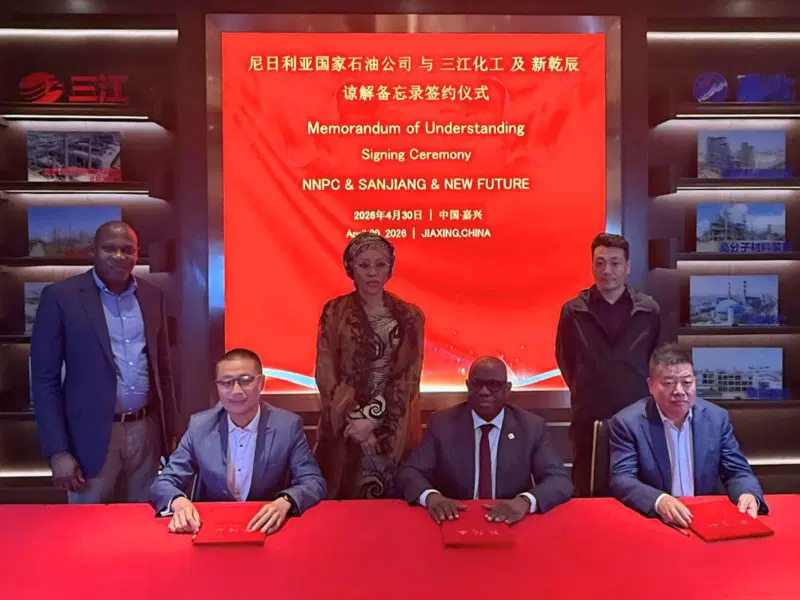
The Nigeria Employers’ Consultative Association (NECA) has raised concerns over the fresh NNPC refinery deal with Chinese firms for the rehabilitation and expansion of the Port Harcourt and Warri refineries, questioning transparency and accountability amid ongoing controversy surrounding past refinery rehabilitation spending estimated at about $25 billion.
Nigeria’s state-owned refineries in Port Harcourt, Warri, and Kaduna have undergone multiple rehabilitation efforts over the past two decades without sustained production outcomes. Successive administrations have approved large-scale funding for turnaround maintenance and rehabilitation projects, yet the facilities have remained largely underperforming or idle.
Recent years have seen renewed attempts by the Nigerian National Petroleum Company Limited (NNPC Ltd) to revive refinery operations through partnerships and technical agreements with foreign firms. These efforts are intended to reduce Nigeria’s dependence on imported refined petroleum products and improve domestic energy security.
However, concerns persist among stakeholders regarding the effectiveness of past investments and the transparency of new arrangements.
NECA stated that while the country urgently needs functional refineries, the latest NNPC refinery deal raises concerns due to what it described as a lack of clarity around previous expenditures and outcomes. The association noted that between 2010 and 2023, Nigeria reportedly spent over ₦11 trillion, estimated at about $25 billion, on refinery rehabilitation, maintenance, and turnaround projects without achieving sustained refinery performance.
NECA’s Director-General, Adewale-Smatt Oyerinde, questioned the rationale behind entering a new agreement without a full audit of earlier projects, stating that Nigerians deserve accountability on how previous funds were utilised.
He explained that the NNPC refinery deal with Chinese firms should not proceed without clear disclosure of technical and financial frameworks, including equity arrangements, procurement processes, and safeguards against cost overruns. NECA further stressed that the NNPC refinery deal must address concerns over recurring failures in refinery rehabilitation projects, which have historically involved multiple funding cycles without delivering consistent output.
The association also reiterated that Nigerian businesses have suffered significantly from energy insecurity, high production costs, and foreign exchange pressures due to reliance on imported fuel products. Oyerinde noted that it would be inappropriate to proceed with another NNPC refinery deal without resolving transparency gaps linked to previous rehabilitation programmes.
The group also argued that structural reforms, including governance improvements and potential concession or privatisation models, should be considered as alternatives to repeated turnaround maintenance cycles.
The ongoing debate over the NNPC refinery deal highlights continued concerns about fiscal accountability in Nigeria’s downstream petroleum sector.
It also reflects broader policy challenges around refinery rehabilitation, energy security, and the effectiveness of public-private partnerships in delivering sustainable infrastructure outcomes. If unresolved, these concerns could further erode public trust in large-scale refinery rehabilitation initiatives and intensify calls for structural reforms in the sector.