






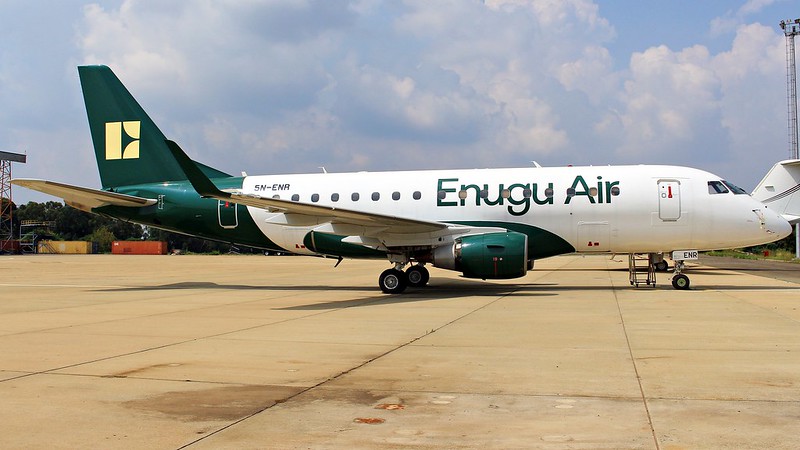
The recent interview by the Secretary to the Enugu State Government, published by Punch Newspapers under the headline “Enugu Air, Airport Concession Key to $30bn GDP Target”, deserves careful examination.
At first glance, the proposition appears attractive: a state-owned airline and an airport concession serving as catalysts for economic transformation. Upon closer scrutiny, however, the argument reveals a fundamental flaw. It appears to confuse transport infrastructure with economic strategy.
An airline does not create economic activity by itself. It transports people and goods generated by economic activity elsewhere. Across the world, successful airports became busy because thriving industries, manufacturing centres, financial hubs, educational institutions, tourism destinations, technology ecosystems, and logistics networks first created demand for travel. Airports responded to growth; they did not create it.
This distinction matters.
The SSG argues that Enugu Air and the concession of the Akanu Ibiam International Airport will contribute significantly to growing Enugu State’s economy from approximately $4.4 billion to $30 billion by 2031. Yet the interview provides little insight into the productive sectors that will generate the passenger and cargo volumes necessary to support such growth.
Where are the industrial parks?
Where are the manufacturing clusters?
Where are the export processing zones?
Where are the technology districts, logistics hubs, agro-processing centres, and large-scale private investments that would justify such ambitious projections?
These questions remain unanswered.
Aviation is ordinarily the consequence of economic growth, not its primary cause.
More importantly, taxpayers are entitled to transparency.
How much public money has been invested in Enugu Air?
What percentage equity does the state own?
What are the projected annual operating costs?
What liabilities or guarantees has the government assumed?
What is the projected break-even period?
What passenger load factor is required for commercial viability?
What independent feasibility studies support the project?
These are not partisan questions. They are questions of accountability.
The absence of clear answers becomes even more significant when one considers that Enugu already enjoys air connectivity through existing carriers. Air Peace, United Nigeria Airlines and other operators already serve the Enugu-Abuja-Lagos corridor and connect the state to major commercial centres.
The issue, therefore, is not whether another airline can fly existing routes.
The issue is whether Enugu is generating sufficient new economic activity to justify additional airline capacity.
Governments that aspire to build aviation hubs usually begin by creating the underlying economic ecosystem that produces demand. They attract industries. They support exporters. They develop conference facilities. They promote medical tourism. They establish logistics centres. They encourage technology investment. They create jobs.
People travel because opportunities exist.
Cargo moves because goods are produced.
Airports prosper because economies prosper.
Viewed from this perspective, the state’s current policy environment presents a troubling contradiction.
Government officials frequently cite tourism and hospitality as key pillars of growth. Yet hotel owners, restaurant operators, and hospitality investors continue to complain about multiple taxation and regulatory burdens. The hospitality sector has openly challenged some of these measures in court.
Economic development rarely flourishes under an environment perceived as hostile to enterprise.
If tourism is genuinely central to Enugu’s economic future, policy should be focused on lowering the cost of doing business, encouraging investment, reducing regulatory friction, and making the state more attractive to entrepreneurs.
It is difficult to promote tourism while simultaneously increasing operational burdens on those expected to provide tourism services.
The same contradiction is visible at the airport itself.
Passengers and visitors increasingly report rising access costs. What was once a relatively simple pickup process has evolved into a system of multiple charges and restricted access. Motorists are required to pay at various stages before completing what should be a routine passenger pickup.
This approach appears designed primarily to maximise fee collection rather than passenger convenience.
Yet successful airports compete aggressively for traffic. They reduce friction. They simplify access. They encourage usage.
An airport growth strategy should focus on reduced access costs, efficient passenger movement, incentives for airlines introducing new routes, cargo facilitation programmes, integrated road and rail connectivity, streamlined logistics services, and coordinated tourism promotion.
These measures stimulate traffic.
Additional charges merely increase costs.
Perhaps the most significant omission in the SSG’s presentation is the absence of a credible explanation for how Enugu intends to attract the millions of additional visitors implied by its projections.
The interview references tourism, agriculture, hospitality, and investment. However, it identifies no major tourism assets, multinational investments, export industries, manufacturing clusters, convention programmes, or large-scale commercial developments capable of generating the projected surge in passenger numbers.
Without such drivers, the state risks building an aviation ecosystem that simply redistributes existing traffic rather than creating new economic value.
This brings us to the central point.
An airline is not an economic development strategy.
An airport concession is not an economic development strategy.
They are instruments.
Tools.
Useful tools, potentially valuable tools, but tools nonetheless.
The true drivers of prosperity remain productive industries, private investment, exports, innovation, entrepreneurship, logistics efficiency, and a competitive business environment.
The question before Enugu is therefore not whether it can own an airline.
The question is whether it is creating the economic conditions that would make such an airline indispensable.
Until that question is answered with evidence, transparency, and measurable economic fundamentals, the promise of a $30 billion economy will continue to sound more aspirational than strategic.
The challenge before policymakers is not to build aircraft. It is to build the economy that fills them.