



An investigative report has detailed how 36 Nigerian nationals were recruited into Russian military service during the ongoing war in Ukraine after being attracted by offers of employment or education overseas, with at least five of them confirmed killed in combat operations, the document says.
The report, titled The Business of Despair: The Russian Army’s Recruiting of African Fighters, was published in February 2026 by the investigative group All Eyes on Wagner.
It draws on data collected between 2023 and mid-2025 from Ukrainian and open-source intelligence, identifying individuals from 36 African countries, including Nigeria, who signed contracts with Russian military units.
Russia’s full-scale invasion of Ukraine began in February 2022 and has continued into 2026, with both sides engaged in prolonged combat in eastern and southern regions of the country.
The report said recruiters used social media platforms such as Facebook, Instagram, Telegram and TikTok to advertise opportunities that appeared to promise legitimate work or study abroad.
These ads often featured images of urban life and symbols of prosperity in Russia.
According to the document, recruiters also leveraged travel agencies to facilitate visa and travel arrangements, with some Nigerians travelling under the impression they were heading to Russia for jobs or education, only to find themselves signing military contracts on arrival.
The report identified 36 Nigerians among those recruited to serve with Russian forces under contract.
Many were described as coming from economically challenged backgrounds and having been attracted by offers of payment, signing bonuses and other incentives.
Among the Nigerian deaths confirmed in the report are:
- Abdoulaye Issaka Ismael, 27
- Agbo Moses Omale, 43
- Adamu Abdulai Ismail, 25
- Mikael, 47
- Fajobi Taiwo Omoniyi, 50
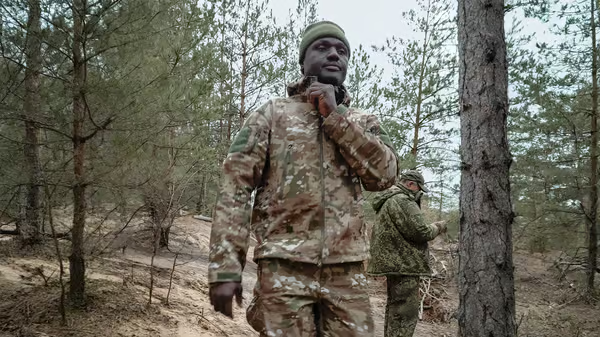
In late November 2025, Ukrainian military intelligence reported that the bodies of two Nigerian men; Hamzat Kazeen Kolawole, 43, and Mbah Stephen Udoka, 38 were discovered in the Luhansk region after they were killed during an assault, and neither had formal military training before deployment.
The report says recruits were often asked to sign contracts in a language they did not understand, with their phones and travel documents seized to restrict communication and mobility.
Testimonies cited in the investigation describe recruits being taken to training camps where minimal preparation was provided before frontline deployment.
One former recruit, identified only as Balogun in a separate account, told researchers that contracts were written in Russian and that recruits were not allowed to use phones or translation tools before signing. He said training was brief and chaotic, and some recruits were quickly sent to combat zones.
The report outlines how recruitment networks appear to operate across international borders, with travel agencies and intermediaries in Nigeria helping candidates secure visas based on false promises.
These agents facilitated travel to Russia, where some individuals were then introduced to military recruitment offices or transport to military camps.
A key recruitment hub identified linked to travel arrangements was alleged to be a Port Harcourt-based company that advertised Russian opportunities online, although the firm later denied involvement in military recruitment and said it discontinued certain services when concerns arose.
The report places Nigeria among other African countries targeted by these campaigns, alongside South Africa, Ghana, Kenya, Uganda, Cameroon and the Gambia.
The Russian Ambassador to Nigeria, Andrey Podyolyshev, has denied that Moscow operates any state-backed programme to recruit Nigerians into Russian forces.
He said Russia was unaware of such recruitment and expressed openness to investigations if substantiated information was provided.
Separately, Nigerian authorities said that an evacuation effort from conflict zones in Russia and Ukraine concluded several years ago and stated that any Nigerians who enlisted under personal choice would be responsible for their actions.
The recruitment and deployment of foreign nationals, including Nigerians, into Russian forces during the Ukraine war reflect broader patterns of foreign personnel being contracted for frontline duties.
Ukrainian officials have reported that more than 1,400 Africans from some 36 countries are known to have been recruited, with many claimed to have seen heavy losses on the battlefield.
Instances recovered by Ukrainian forces, including the identification of bodies in the Luhansk region and testimonies of captured or escaped individuals, indicate that recruits often entered the conflict with little military training and were deployed into high-risk operations.